BOOKS OF ORIGINAL ENTRIES
These are the books of first entry. The transactions are first recorded in these books before being entered in the ledger books. These books are also called as books of Prime entry or Subsidiary books. They are six in number.
1. Purchases Journal (or Purchases Book) used to record all credit purchases of goods. It is written up from invoice.
2. Sales Journal (or Sales Book) is used to record all the credit sales of goods. It is written up from the invoice.
3. Sales Returns Journal (or Return Inwards Book): It is used to record all returns inwards. It is written up from the copies of the credit notes send to customers.
4. Purchases Return Journal (or Returns Outwards Book): It is used to record all purchases returns. It is written up from the credit notes received from the suppliers.
5. Cash Book: It is used to record all receipts and payments of cash and cheques. It is been given the ruling in such a way that it acts both as a book of original entry and ledger account.
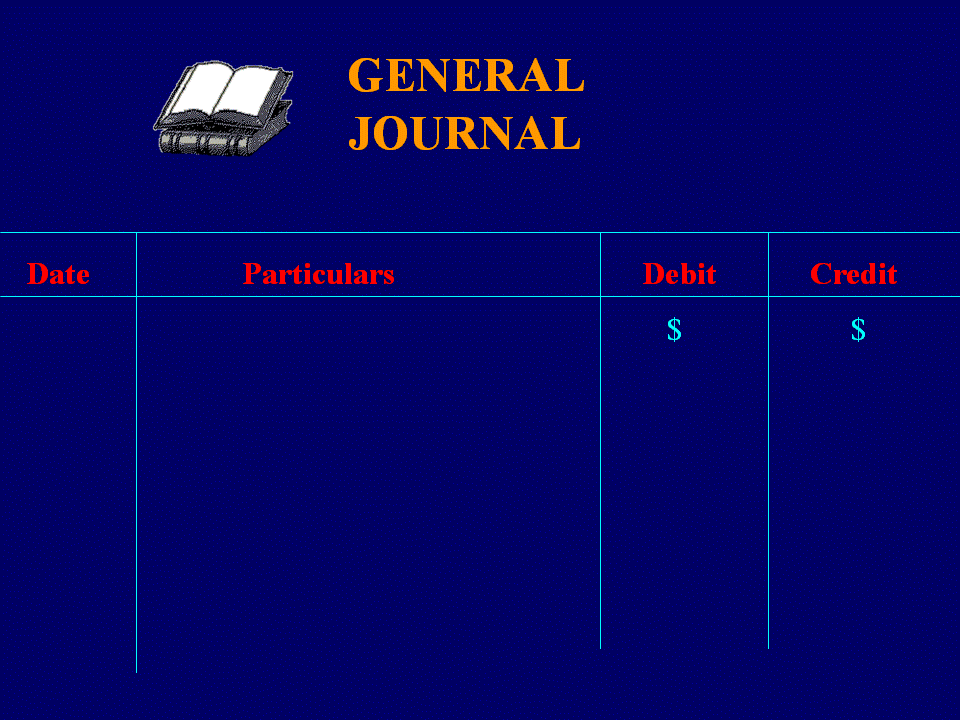
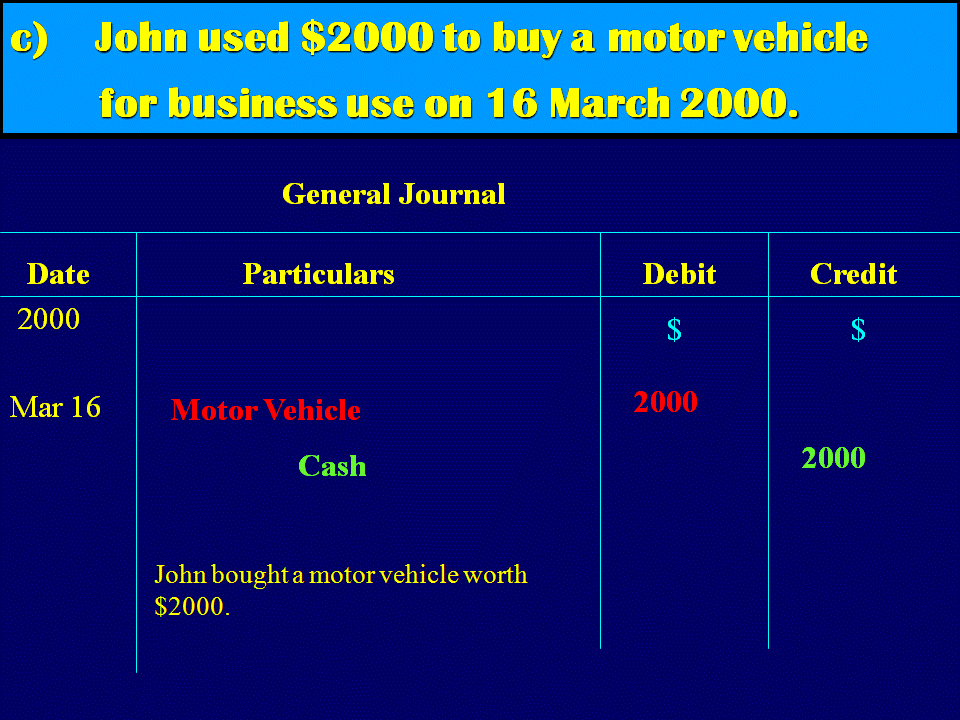
6. General Journal (or Journal): This book is used to record all those items or transactions that can not be recorded in any other book of original entry like
i. Correction of errors
ii. Opening entries
iii. Purchase or Sale of Assets on Credit etc.
Sunday, 24 July 2011


PETTY CASH BOOK
PETTY CASH BOOK
Imprest System: It is a system where a reimbursement is made of the total amount paid in a period or it can also be called as a system where petty cashier begin each new accounting period with the same amount of petty cash.
Advantages Of Petty Cash Book:
1. The number of entries in the main cashbook is reduced.
2. The main cashier’s burden is reduced.
3. The chances of mistakes in recording is minimised.
4. Posting become more easy with the Total’s Analysis Columns.
Advantages of using Analysis columns:
It let us know the money spent on each different nature of small expense.
The double entry for each analysis column by transferring the totals of the analysis columns to their respective accounts which are available in the General ledger.
Imprest System: It is a system where a reimbursement is made of the total amount paid in a period or it can also be called as a system where petty cashier begin each new accounting period with the same amount of petty cash.
Advantages Of Petty Cash Book:
1. The number of entries in the main cashbook is reduced.
2. The main cashier’s burden is reduced.
3. The chances of mistakes in recording is minimised.
4. Posting become more easy with the Total’s Analysis Columns.
Advantages of using Analysis columns:
It let us know the money spent on each different nature of small expense.
The double entry for each analysis column by transferring the totals of the analysis columns to their respective accounts which are available in the General ledger.
Cash Book
CASH BOOK
Cash book is the only book of original entry which is given ruling in such a way that it could act at the same time as a book of original entry and as a ledger account.
1. Trade Discount: It is an allowance or deduction given by the supplier to the retailer on the catalogue price or list price.
i. It is given to encourage him to buy in bulk.
ii. It is given so that retailer could make some profit.
Note: It is not recorded in the books either by the seller or the buyer.
2. Cash Discount: It is an allowance or deduction given by the receiver of cash to the payer of cash for prompt payment.
It is of two types discount allowed and discount received.
i. It is given to encourage the payer to pay on or before the due date.
ii. Note: This discount is recorded in the Cash Book. Discount allowed is recorded at the debit side and discount received on the credit side.
iii. Note: Discount columns are never balanced. It is just totalled.
iv. Note: Every month the Total’s of discount allowed column is transferred to debit side of Discount allowed account in General ledger and the total of discount-received column is transferred to the credit side of Discount received account in the General ledger.
2. Contra Entry: When a transaction effects both cash and bank accounts at the same time, such entries are called as Contra Entries.
Cash book is the only book of original entry which is given ruling in such a way that it could act at the same time as a book of original entry and as a ledger account.
1. Trade Discount: It is an allowance or deduction given by the supplier to the retailer on the catalogue price or list price.
i. It is given to encourage him to buy in bulk.
ii. It is given so that retailer could make some profit.
Note: It is not recorded in the books either by the seller or the buyer.
2. Cash Discount: It is an allowance or deduction given by the receiver of cash to the payer of cash for prompt payment.
It is of two types discount allowed and discount received.
i. It is given to encourage the payer to pay on or before the due date.
ii. Note: This discount is recorded in the Cash Book. Discount allowed is recorded at the debit side and discount received on the credit side.
iii. Note: Discount columns are never balanced. It is just totalled.
iv. Note: Every month the Total’s of discount allowed column is transferred to debit side of Discount allowed account in General ledger and the total of discount-received column is transferred to the credit side of Discount received account in the General ledger.
2. Contra Entry: When a transaction effects both cash and bank accounts at the same time, such entries are called as Contra Entries.
Bank Reconciliation Statement
BANK RECONCILIATION STATEMENT
The purpose of bank reconciliation statement is to explain any difference between the bank balance appearing on the bank statement provided by the bank..
Reasons For Difference:
Sometimes it so happen that some entries are made in cash book but they are not recorded in the bank. Like.
1. Cheques deposited but not credited in the Bank.
2. Cheques issued but are not presented in the bank.
Sometimes it so happens that some entries are made in bank statement but they are not recorded in cashbook. Like.
1. Direct deposits in the bank by our customers
2. Direct collections made by the bank on our behalf
3. Direct payments made by bank
4. Interest allowed by the bank and charged by the bank
5. Dishonoured cheques.
Therefore a statement is prepared to reconcile this difference. This statement is called as “Bank Reconciliation statement”.
Methods Of Preparing Bank Reconciliation Statement:
Step I: Compare the bank column of the cashbook with the bank statement. Tick all those receipts and payments which can be found in both the cash book and the bank statement, when this has been done, there remains some unticked items in cash book and the bank statement.
Step II: Make Adjusted cash book by taking into account all the existing cash book entries plus the unticked bank statement items into the cash book and calculate the new balance. This balance is considered as the true bank balance of the business and this figure will be shown in the balance sheet as bank balance.
Step III: Prepare Bank Reconciliation Statement.
Note: When we prepare B.R.S. we do not look at the entries of bank statement. We just take into account the entries which are in Cash Book but not in Bank Statement.
1. Start with the balance shown in the Adjusted cash book..
2. Add the entries that are credited in the cash book but not debited on the bank statement. (unpresented cheques)
3. Deduct any items that are debited in the cash book but are not credited in the bank statement.
The resulting figure should be equal to Bank Statement balance.
Reasons For Preparing bank Reconciliation Statement:
1. To ensure that the cash book entries are complete.
2. To discover bank errors.
3. To discover errors in cash book.
4. To check Fraud and embezzlement.
5. To discover dishonoured cheques.
The purpose of bank reconciliation statement is to explain any difference between the bank balance appearing on the bank statement provided by the bank..
Reasons For Difference:
Sometimes it so happen that some entries are made in cash book but they are not recorded in the bank. Like.
1. Cheques deposited but not credited in the Bank.
2. Cheques issued but are not presented in the bank.
Sometimes it so happens that some entries are made in bank statement but they are not recorded in cashbook. Like.
1. Direct deposits in the bank by our customers
2. Direct collections made by the bank on our behalf
3. Direct payments made by bank
4. Interest allowed by the bank and charged by the bank
5. Dishonoured cheques.
Therefore a statement is prepared to reconcile this difference. This statement is called as “Bank Reconciliation statement”.
Methods Of Preparing Bank Reconciliation Statement:
Step I: Compare the bank column of the cashbook with the bank statement. Tick all those receipts and payments which can be found in both the cash book and the bank statement, when this has been done, there remains some unticked items in cash book and the bank statement.
Step II: Make Adjusted cash book by taking into account all the existing cash book entries plus the unticked bank statement items into the cash book and calculate the new balance. This balance is considered as the true bank balance of the business and this figure will be shown in the balance sheet as bank balance.
Step III: Prepare Bank Reconciliation Statement.
Note: When we prepare B.R.S. we do not look at the entries of bank statement. We just take into account the entries which are in Cash Book but not in Bank Statement.
1. Start with the balance shown in the Adjusted cash book..
2. Add the entries that are credited in the cash book but not debited on the bank statement. (unpresented cheques)
3. Deduct any items that are debited in the cash book but are not credited in the bank statement.
The resulting figure should be equal to Bank Statement balance.
Reasons For Preparing bank Reconciliation Statement:
1. To ensure that the cash book entries are complete.
2. To discover bank errors.
3. To discover errors in cash book.
4. To check Fraud and embezzlement.
5. To discover dishonoured cheques.






Thursday, 7 July 2011
Debit or Credit k Asool!
Debit or Credit k Asool!
In asoolo se pehlay app ko batata chaloon k Accounting 4 pillars pe khari hay. Jaisy 4 families kon kon se?
1. Assets
o Cash in hand
o Cash at Bank
o Furniture
o Office Equipment
o Plant
o Machinery
o Buildings
o Closing Stock
o Debtors ( jin ko udhaar pe sale ki jati hay)
o Receivables (Rent, Commission, Interest)
o Bills Receivable
o Purchases (aik kisam ka asset)
o Vehicles (Cars, Truck, Motor Bike, Bus, Van,)
o Prepaid expenses
2. Expenses
o Salaries
o Wages
o Utility Bills ( Gas, Electricity, Telephone, etc)
o Commission Paid
o Discount Allowed
o Depreciation
o Interest paid
o Rent paid
o Charity
o Advertisement expense
o Any Loss ( choori ho gayee ya aag lag gayee)
o Stationary
o Carriage
o Drawings (aik kisam ka expense lakin asal main Capital ki amount kam hoti hay)
o Freight
o
3. Liabilities ( Owner’s Equity bhi aik kisam ki liability hai)
o Capital
o Creditors ( jin se udhaar khareeda jata hay)
o Payables (Tax, rent, Salaries, wages, etc)
o Bills payable
4. Income/Revenue
o Sales
o Commission received
o Rent received
o Interest Received
o
This is the property of http://www.youlearners.com and http://www.youlearners.blogspot.com and www.youlearners.com/forum
For Online Free help please register yourself on the above website.
We are also offer free Live Class with High Qualified Person like
(MBA, ACCA, PIPFA, CA for accountancy and soon MSC for science subjects and MIT for computer)
Asool Number 1
Her entry main se kam se kam do account dhondanay hain jaisa k
· Ahmed Started Business with Cash Rs. 100,000/-
· Or
· Ahmed Commenced Business with cash Rs 100,000/-
· Or
· Ahmed Invested Rs. 100,000/-
In entries main do terha k account hain aik to Cash jo k saaf zahir hay or doosra Capital kion k Ahmed ne new business start kia hay or jab bhi koi new business start kerta hai to wo invest kerta hay or apnay business main apni investment Capital kehlati hay is ko owner’s Equity bhi kehtay hain
Accounts | Families | Increase / Decrease | Debit / Credit |
Cash | |||
Capital |
Asool Number 2
In dono accounts Cash or Capital ko dekhna or soochna hay k yeh oper batay gayee 4 main se kis family se taluq rukhtay hain
1. Asset
2. Expense
3. Liability
4. Income/Revenue
To hum ne dekha k Cash Assets ka hisa hay or Capital Libility se taluq rukhta hay
Accounts | Families | Increase / Decrease | Debit / Credit |
Cash | Assets | ||
Capital | Liability |
Asool Number 3
Ab sab se ziada yaad rekhnay wali baat
Pehly dono families yani k Asset and Expense main jab bhi Izafa ho ga to wo Debit hoon gi
Pehly dono families yani k Asset and Expense main jab bhi Kami ho gi to wo Credit hoon gi
Akhri dono families yani k Liability and Income/Revenue main jab bhi Izafa ho ga to wo Credit hoon gi
Akhri dono families yani k Liability and Income/Revenue main jab bhi Kami ho gi to wo Debit hoon gi
Asset | Expense | Liability | Income/Revenue |
If Increase then Dr | If Increase then Dr | If Increase then Cr | If Increase then Cr |
If Decrease then Cr | If Decrease then Cr | If Decrease then Dr | If Decrease then Dr |
Ab hum ne dekha k Cash business main berh raha hay kion k pehlay business k pass kuch nahi tha is liay yeh Debit (Dr) ho ga
Or isi terha business ki liability bhi berh rahi hay kion k pehlay us business se humain kush wapis nahi lena tha is liay wo Credit (Cr) ho ga
Accounts | Families | Increase / Decrease | Debit / Credit |
Cash | Assets | Increase | Dr |
Capital | Liability | Increase | Cr |
ab or examples
· He open a bank account in MCB Bank and deposit there Rs. 30,000/-
Accounts | Families | Increase / Decrease | Debit / Credit |
Bank | Asset | Increase | Dr |
Cash | Asset | decrease | Cr |
· He Borrows Rs 50,000/- from Miss Zaima at 12% interest annually
· OR
· He Borrows Rs 50,000/- from Miss Zaima
· OR
· He Borrows Rs 50,000/- from Miss Zaima at 12% interest per annum (p.a.)
Accounts | Families | Increase / Decrease | Debit / Credit |
Cash | Asset | Increase | Dr |
Creditor (Zaima) | Liability | Increase | Cr |
Is entry main sirf jo loan lia gaya hay us ki entry kerna hay 12% saal k end main deina hay to us ki entry sall k akhir main hi kerian gay kion k interest salaana daina hay to entry bhi saal k end main hi kerain gay | |||
· He Purchase furniture worth Rs. 20,000/- for Cash
Accounts | Families | Increase / Decrease | Debit / Credit |
Furniture | Asset | Increase | Dr |
Cash | Asset | decrease | Cr |
· He purchases goods from Mr. Dogar for Rs 25,000/- and paid cash Rs. 15,000/-
Accounts | Families | Increase / Decrease | Debit / Credit |
Purchases | Asset | Increase | Dr |
Cash | Asset | decrease | Cr |
Mr Dogar (Creditor) | Liability | Increase | Cr |
· He Sells goods for cash Rs. 9,000/-
Accounts | Families | Increase / Decrease | Debit / Credit |
Cash | Asset | Increase | Dr |
SALES | Income/Revenue | Increase | Cr |
· He sells goods for Rs. 5,000/- to Mr. Amjad on credit basis
· or
· He sells goods for Rs. 5,000/- to Mr. Amjad on account
· Or
· He sells goods for Rs. 5,000/- to Mr. Amjad
Accounts | Families | Increase / Decrease | Debit / Credit |
Amjad (Debtor) | Asset | Increase | Dr |
SALES | Income/Revenue | Increase | Cr |
· He Purchases Stationery for Rs. 3000/-
Accounts | Families | Increase / Decrease | Debit / Credit |
Stationery | Expense | Increase | Dr |
Cash | Asset | decrease | Cr |
· He Purchases a fan for Rs. 2,000/- and safe for Rs. 8,000/- and pays by cheque
Accounts | Families | Increase / Decrease | Debit / Credit |
Fan | Asset | Increase | Dr |
Safe | Asset | Increase | Dr |
Bank (MCB) | Asset | Decrease | Cr |
Jab bhi koi payment via cheque ki jay ki to humaray bank main se paisy kam hon gay to humara Bank account credit ho ga | |||
· He pays Rs.6000/- to Mr Dogar on account
Accounts | Families | Increase / Decrease | Debit / Credit |
Mr Dogar (Creditor) | Liability | Decrease | Dr |
Cash | Asset | decrease | Cr |
Mr Dogar se hum ne good purchase ki thee to wo humary liability bun gaya tha. Ab hum us ko kuch payment ker rahay hain to wo utni amount se kam ho jay ga to is wastay Mr Dogar Dr ho ga | |||
· He returns defective goods to Mr Dogar worth Rs. 1,000/-
Accounts | Families | Increase / Decrease | Debit / Credit |
Mr Dogar Creditor | Liability | Decrease | Dr |
Purchase return | Asset | decrease | Cr |
Mr Dogar se hume jo goods purchase ki thee wo defective nikly to hum ne us ko wapis ker di. Is se ab hum ne us k kam paisy wapis kernay hain to liability decrease ho jay gi. Or humara assets bhi kam ho jay ga. | |||
· Goods are returned by Mr Amjad Rs 500/- to the business
Accounts | Families | Increase / Decrease | Debit / Credit |
Sales Return | Income/Revenue | Decrease | Dr |
Mr Amjad (Debtor) | Asset | decrease | Cr |
Jis terha hum ne defective goods return ki isi terha Mr Amjad ne hum ko Defective goods wapis ki jis se humary Sales kum ho gayee to Dr or assets bhi kam ho gaya to Cr | |||
· Cash Paid to Mr Dogar Rs 2,800/- in full satisfaction of his claim of Rs. 3,000/-
Accounts | Families | Increase / Decrease | Debit / Credit |
Mr Dogar Creditor | Liability | Decrease | Dr |
Cash | Asset | Decrease | Cr |
Discount Received | Income/ Revenue | Increase | Cr |
In entry main 3 account involve huway Mr Dogar ki payment 3000 settle ker di 2800 cash de ker 200 dicount hasil ker k | |||
· Cash received from Mr. Amjad Rs.4400/- in full satisfaction of his debts of Rs. 4500/-
Accounts | Families | Increase / Decrease | Debit / Credit |
Cash | Assets | Increase | Dr |
Discount Allowed | Expense | Increase | Dr |
Mr Amjad Debtor | Assets | Decrease | Cr |
Is entry main Mr Amjad se hum ne 4500 lena tha per us ne hum ko 4400 dia jis ki wajah se Discount expense ki soorat main samnay aya | |||
· Cash withdrawn from the bank for business use Rs.5000/-
Cash | Asset | Increase | Dr |
Bank (MCB) | Asset | Decrease | Cr |
Cash Bank se kam ho gaya or Office main cash main izafa ho gaya | |||
Interest is paid on Money
Subscribe to:
Posts (Atom)